
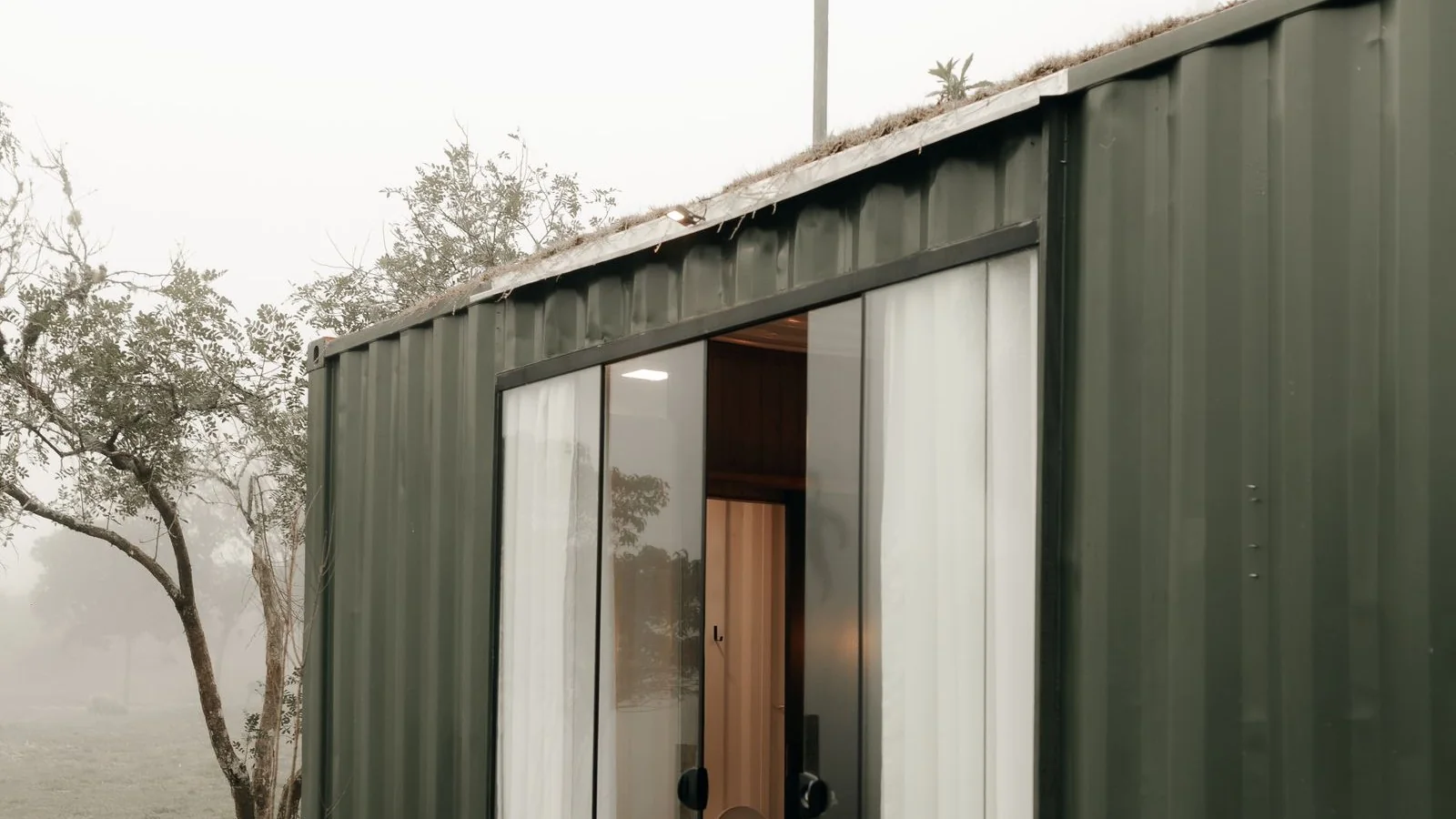
Direct answer: it is possible to build a container house in the Algarve, but in practice it is a problematic solution. The three weak points are licensing (there is no exemption relative to traditional construction), thermal insulation (steel is a very poor conductor and creates severe thermal bridges in the Algarve climate) and resale (limited market, hesitant banks). For the same budget, a Passive House panel-frame modular home delivers far more quality, comfort and property value.
In recent years, "container houses" have gained visibility on social media and lifestyle features — images of shipping containers converted into rural cabins, minimalist offices or low-cost holiday homes. The idea is attractive: a 40-foot container costs €3,000-6,000 second-hand, has a robust structure ready to use and can be "modular" by stacking units. But when you crunch the real numbers in the Algarve, the picture changes completely.
What a container house is
A container house is, in its strictest definition, a home built from refurbished ISO shipping containers (typically 20 ft with 15 m² or 40 ft with 30 m²). The COR-TEN steel structure is cut to open windows and doors, reinforced where it loses structural rigidity, insulated inside or outside, clad and fitted with services. The final product ranges from an austere "metal cabin" to contemporary architecture with multiple stacked containers.
In Portugal, the container house market is fragmented. There are three types of supplier: manufacturers that sell raw containers, "customisers" that deliver a container with a basic interior (2-4 weeks of work, no licensing), and a small group of architecture studios that handle the entire licensed process. It is essential to understand who you are dealing with — differences in price and warranty are enormous.
Licensing in Portugal: no exemption at all
This is the first myth to debunk. In Portugal, a container house placed on a plot for residential use is new construction for the purposes of the Legal Regime for Urbanisation and Building (RJUE, Decree-Law 555/99 — the Portuguese building code). That means:
- Architectural project signed by an architect registered with the Order, with plans, elevations and descriptive memorandum.
- Engineering specialities (structural, thermal DL 101-D/2020, acoustics RRAE, electrical, ITED telecoms, gas, water, drainage and SCIE fire safety).
- Prior communication with deadline or building permit application, depending on the applicable PDM (Portuguese municipal master plan).
- Equivalent municipal council fees (TMU, TRIU and administrative charges).
- Final inspection and issuance of the occupancy licence.
No municipal council in the Algarve grants special treatment because the house comes from a shipping container. In Loulé, Silves, Albufeira and Faro, the process is exactly the same as for a traditional home. If you hear anyone say "container houses don't need licensing", you are buying legal problems and a demolition order.
Real price in the Algarve: €40,000-120,000
The table below reflects real 2026 prices in the Algarve market, with data gathered from three independent suppliers and cross-checked with proposals presented to end clients.
| Component | Container T0 30 m² | Container T1 45 m² | Modular PH T1 55 m² |
|---|---|---|---|
| Used container(s) | €4,500 | €8,000 | — |
| Structure/reinforcement/cutting | €6,000 | €10,000 | Included |
| Insulation (200 mm) | €5,500 | €8,500 | Included |
| Exterior cladding | €4,000 | €6,500 | Included |
| Windows and doors | €3,500 | €5,500 | Included |
| Complete installations | €7,000 | €10,500 | Included |
| Interior finishes | €8,000 | €13,000 | Included |
| Kitchen and bathrooms | €4,500 | €7,500 | Included |
| Design and licensing | €6,000 | €8,000 | Included |
| Foundations and siting | €4,500 | €6,000 | Included |
| Transport and assembly | €2,500 | €3,500 | Included |
| Total excluding land | ≈ €56,000 | ≈ €87,000 | ≈ €96,000 |
Note what these numbers show: when you add up everything a container house needs to be legally habitable and minimally comfortable, the price difference versus a 55 m² Passive House modular home is only around 10%. And the difference in final quality, thermal comfort and property value doesn't justify saving that amount.
Thermal problem: steel in the Algarve climate
Steel has thermal conductivity around 50 W/m·K. Structural KVH timber has 0.13 W/m·K. That is a difference of almost 400 times. It means that any point where the steel structure of the container forms a thermal bridge between interior and exterior lets heat in or out as if you had a window open.
In the Algarve, with outdoor temperatures above 40°C in August and direct sunshine 300 days a year, this is a serious technical problem. The known solutions require:
- Continuous external insulation (ETICS or ventilated cavity) with 200-250 mm of graphite EPS or mineral wool.
- Radiant barrier on the roof to reflect direct solar load.
- Elimination of every thermal bridge in metal elements that cross the envelope.
- Mechanical ventilation with heat recovery (MVHR) to manage humidity.
When you apply all this, the container "disappears" visually behind the insulation and cladding — it is no longer recognisable as a container. And the cost gets very close to Passive House panel-frame. If you're after the "exposed container" aesthetic, thermal performance can't be Passive House.
Durability and maintenance in the Algarve
The COR-TEN steel of shipping containers is designed for 15-20 years in a marine environment with regular maintenance. In Algarve conditions — proximity to the coast, salinity carried by breeze, cycles of extreme heat and night-time humidity — corrosion accelerates. Recommended inspections are:
| Element | Frequency | Typical cost |
|---|---|---|
| Exterior corrosion inspection | Annual | €150-300 |
| Anti-corrosion repainting | 5-8 years | €1,500-3,500 |
| Joint replacement | 10 years | €500-1,200 |
| Localised structural reinforcement | 15-20 years | €2,000-5,000 |
A panel-frame modular home with KVH structure and treated timber slat cladding requires much less maintenance: refresh of timber paintwork every 8-10 years (€300-800) and airtightness check every 15 years. Over 25 years, the accumulated maintenance difference easily exceeds €8,000-15,000.
Numerical comparison with a T2 Passive House modular
To make the decision clearer, let's compare a concrete scenario: two clients with the same plot in Silves, total construction budget around €120,000 (excluding land), seeking 60-70 m² of usable space.
| Criterion | Container house T2 60 m² | Modular PH T2 65 m² |
|---|---|---|
| Turnkey price | €115,000 | €125,000 |
| Annual energy consumption | 90-140 kWh/m² | 15-25 kWh/m² |
| Annual bill (reference) | €1,400-1,900 | €250-400 |
| Structural service life | 25-40 years | 60-80 years |
| Maintenance over 25 years | €12,000-20,000 | €3,000-5,000 |
| Property value (market reference) | €1,400-1,700/m² | €2,300-2,900/m² |
| Bank financing | Rare / low LTV | Normal / LTV 80% |
| Acoustic insulation | Low | High |
The initial price difference of €10,000 is recovered in under 8 years on energy bills alone. Over 25 years, the total cost of ownership of the Passive House modular home is €25,000-45,000 lower than the container's, with better comfort and superior resale value.
Where a container house does make sense
We don't want to be unfair: there are scenarios where a container house is a defensible option.
- Detached office or studio on the plot — non-permanent use, tight budget, short lead time.
- Agricultural support or very rural weekend home — where the plot is rustic with specific licensing and the use is seasonal.
- Studio for concept-led rural tourism — when the exposed container is deliberately part of the guest experience.
- Temporary housing during works on the main house — 12-24 month solution.
For permanent family housing, with children, ageing occupants, four-season comfort and a 20-30 year horizon, the container loses. In any serious analysis.
"The shipping container was designed to transport cargo on container ships, not to house people in Silves or Loulé in the summer. When we adapt it for housing, either we accept poor thermal performance or we eliminate the original aesthetic with heavy insulation — losing the supposed economic advantage."
Conclusion
The container house in the Algarve is a niche solution. It works for very specific uses, very tight budgets and clients who understand its limitations. It is not a competitive alternative to a Passive House modular home for permanent family housing — not in final price, not in comfort, not in property value.
If you are considering a container because of price, first ask Ecoimport Wood for a Passive House modular quote. You'll see that the difference in initial investment is smaller than you imagine, and the difference in service life, comfort and resale is enormous. Also see our Villa Algarve and Villa Algoz models for a reference of architecture, floor area and finishes per price bracket.
Figures and comparisons shown are 2026 market estimates and may vary by project, plot and supplier.
→ Get your turnkey modular quote (48h response) or visit our technology page to understand why KVH panel-frame beats containers in the Algarve.