
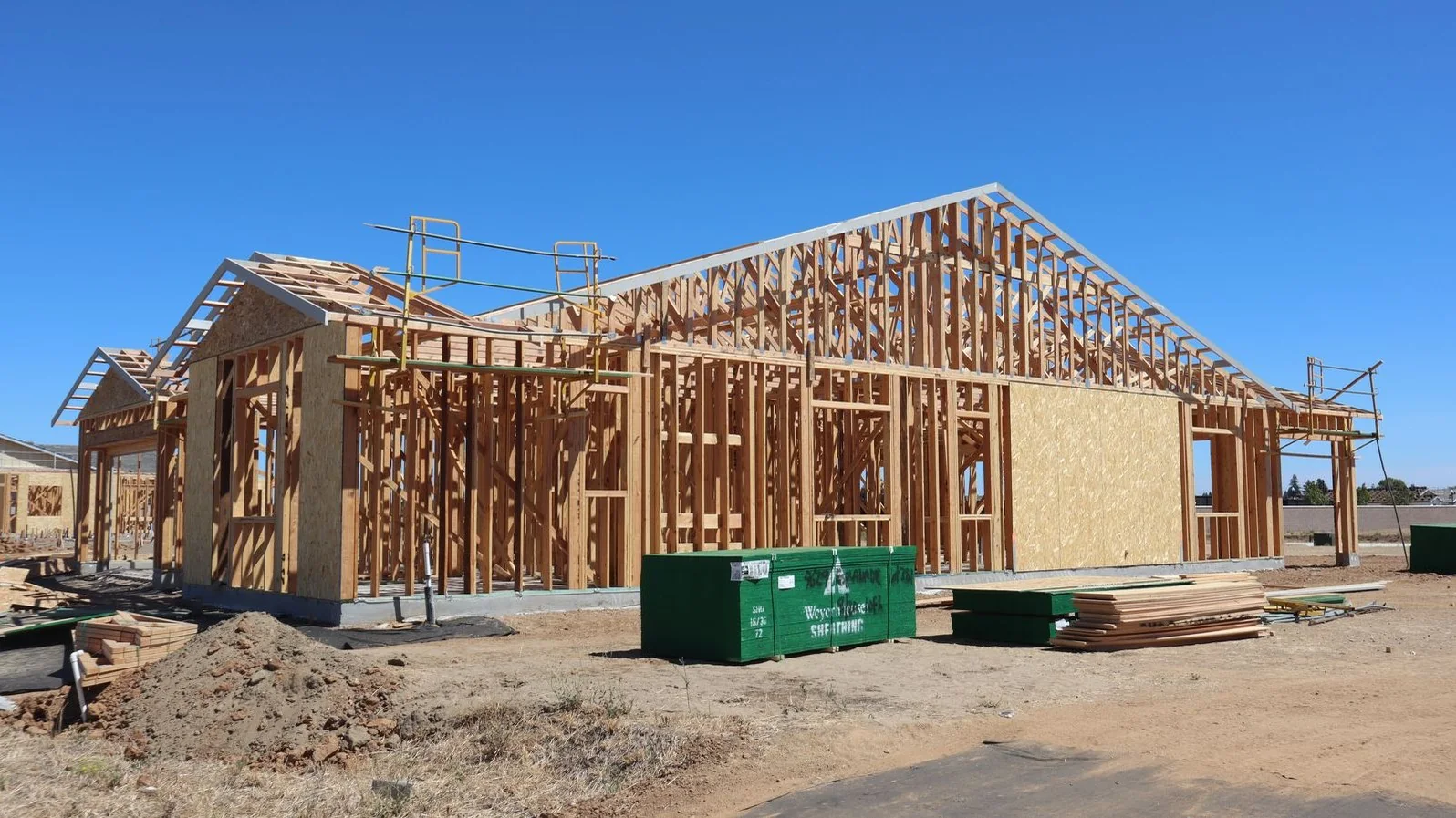
Direct answer: a wooden house kit saves money on paper — the advertised price (€12,000-25,000) is only the basic pack. When you add up everything a real house needs (prepared plot, foundations, assembly, installations, finishes, licensing and rework), the total cost gets close to a turnkey modular (€250,000-320,000 vs €315,000), but with much more risk of overruns, delays and final quality. For 90% of clients, a kit is not worth it.
Wooden house kits proliferate on online platforms, European portals and Chinese/Eastern European export sites. The images are attractive and the "starting" prices go viral. But anyone who has completed a build this way knows the final price and effort have nothing to do with what was promised. This article does the real sums.
What a wooden house kit is
A kit is a prefabricated set of structural materials and envelope for a timber house, delivered in a container or on pallets on the client's plot. It typically includes:
- Timber structural framing (KVH, C24 or similar).
- Pre-cut or pre-assembled wall panels.
- Rafters and joists for the roof.
- Metal fixings.
- Assembly manual (not always in Portuguese).
- Sometimes: windows, exterior doors, membranes.
It does not typically include:
- Foundations and earthworks.
- Assembly labour.
- Electrical, plumbing, gas, ITED installations.
- Roof and floor insulation.
- Interior finishes (walls, floors, ceilings).
- Bathroom, kitchen, sanitary ware.
- Design, licensing, fees.
- Energy certificate and final inspection.
- Cross-border transport (sometimes €3,000-8,000).
Real price: what's advertised vs what it costs
Let's break down a real example: a 60 m² kit advertised at €22,000, a licensable T1 in the Algarve, delivered on a plot with urban infrastructure.
| Item | Estimated cost 2026 |
|---|---|
| Kit (structure, panels, roof) | €22,000 |
| Transport + unloading on-site | €2,500 |
| Architectural project + engineering (adaptation) | €7,500 |
| Municipal council fees and licensing | €4,500 |
| Earthworks and footings | €8,500 |
| 15 cm reinforced concrete slab + XPS | €7,000 |
| Structural assembly (local tradespeople) | €18,000 |
| Additional insulation (roof + floor) | €6,500 |
| Membranes + airtightness | €3,500 |
| Complete electrical network | €5,500 |
| Plumbing network + DHW | €4,500 |
| Gas network + drainage | €2,500 |
| MVHR + ventilation (not Passive House) | €3,500 |
| Exterior cladding (slats + paint) | €4,500 |
| Interior finishes (floors, paint, ceilings) | €15,000 |
| Interior doors + skirting boards | €3,000 |
| Complete bathroom (fittings + tiling) | €4,500 |
| Standard equipped kitchen | €7,000 |
| Technical coordination (clerk of works) | €5,500 |
| Estimated rework (10-15% typical) | €13,500 |
| Energy certificate | €750 |
| Total cost T1 60 m² kit build | ≈ €149,750 |
The kit advertised at €22,000 becomes a real build of €150,000 — nearly 7× the "starting" price. And that's without going Passive House. For a T3 130 m² the typical extrapolation gives €250,000-320,000, very close to the equivalent turnkey modular.
Hidden total cost: where the kit really spends
The items that usually surprise the client:
- Rework and adjustments — kits don't always arrive with the right dimensions for the locally licensed project. On-site adjustments cost 10-15% extra.
- Additional insulation — the kit typically comes with 100-120 mm insulation. For Algarve comfort, roof and floor need to be reinforced.
- Complete installations — never come with the kit. Electrical, plumbing, gas, MVHR, drainage, ITED telecoms — all contracted separately.
- Interior finishes — never with the kit. Floors, paint, ceilings, interior doors, skirting — 15-25% of total cost.
- Bathrooms and kitchen — never with the kit. Fittings, tiling, taps, furniture, appliances.
- Technical coordination — if you're not experienced, you need a clerk of works at €800-1,500/month for 8-12 months.
Real time: 8-14 months vs 6 months
The "kit is fast" argument is only true on very simple builds with an experienced client. In practice, with licensing, local tradespeople and coordination:
| Phase | Self-coordinated kit | Turnkey modular |
|---|---|---|
| Design and licensing | 3-5 months | 2-3 months |
| Arrival of materials/kit | 1-3 months (import) | Included |
| Foundations and siting | 4-6 weeks | 3-4 weeks |
| Structural assembly | 4-8 weeks (tradespeople) | 1 week (in-house team) |
| Installations and finishes | 4-6 months (subcontractors) | 6-8 weeks (integrated) |
| Inspection and occupancy licence | 4-8 weeks | 2-4 weeks |
| Total to move-in | 12-18 months | 6-8 months |
A difference of 6-10 months means: parallel rent (€750-1,500/month × 8 months = €6,000-12,000), family stress, delayed move-in, and sometimes partial dropouts that generate new costs.
Licensing: the manufacturer does NOT handle it
This is the point that most surprises less-prepared clients. The kit manufacturer sells materials — they are not responsible for licensing in Portugal. The client has to:
- Hire a local architect (€2,500-4,500).
- Hire engineering specialists (€3,500-5,500 combined).
- Adapt the architectural project to the specific kit (not always trivial).
- File the licensing process at the municipal council.
- Handle municipal council queries, alterations and resubmissions.
- Hire a construction safety coordinator (legally required).
- Give prior notice of subcontractors to the ACT (Portuguese labour authority).
- Request final inspection and issuance of occupancy licence.
If any step is missed, the works are halted. There is no "certified kit" that avoids this process.
Warranty: who covers what
This is the most critical difference in legal and financial terms.
| Coverage | Kit | Turnkey modular |
|---|---|---|
| Kit materials | 5-10 years, manufacturer | Included |
| Assembled structure | None direct | 10-year decennial |
| Insulation and airtightness | Depends on subcontractor | 5 years legal + contractual |
| Electrical installations | From the contracted electrician | Included with the builder |
| Plumbing installations | From the contracted plumber | Included with the builder |
| Single point of contact for defects | No — client identifies the source | Yes — single builder |
| Decennial insurance (mandatory) | Client has to contract it | Included |
With a kit, if damp appears on a wall after 3 years, the client has to prove whether it came from the kit material (manufacturer), from the assembly (tradesperson) or from the airtightness work (subcontractor). Each blames the other. With turnkey modular, there is a single entity responsible — activate warranty, resolve, done.
Passive House with a kit: virtually impossible
Standard kits are not designed for Passive House. They lack:
- Continuous 240-300 mm insulation (most come with 100-140 mm).
- Managed vapour barrier at every critical junction.
- Systematic elimination of thermal bridges in the structure.
- Passive House-certified frames (triple-glazed windows Uw ≤ 0.80).
- PHI-certified mechanical ventilation with heat recovery.
- Blower door test confirming n50 ≤ 0.6 1/h before closing walls.
Adapting a kit for Passive House requires a specialist architect, PHPP calculation and panel redesign. The additional cost is around 25-35% and destroys any economic advantage of the initial kit.
5-year TCO: real comparison
A T3 130 m² house in the Algarve, 5-year comparison between self-coordinated kit and turnkey Passive House modular.
| Item | Kit T3 130 m² | Turnkey PH T3 130 m² |
|---|---|---|
| Kit / panels (base) | €45,000 | Included |
| Foundations + slab | €18,000 | Included |
| Design + licensing | €15,000 | Included |
| Assembly + subcontracts | €75,000 | Included |
| Complete installations | €32,000 | Included |
| Finishes + kitchen + bathroom | €52,000 | Included |
| Technical coordination | €10,500 | Included |
| Rework + overruns (15%) | €37,000 | Zero (fixed price) |
| Rent during extended build | €10,500 | €3,500 (short build) |
| Total initial investment | €295,000 | €315,000 |
| 5-year energy (non-PH) | €10,500 | €2,200 |
| 5-year fixes and adjustments | €4,500 | €0 (warranty) |
| 5-year TCO | €310,000 | €317,200 |
The 5-year TCO difference is only €7,200 (2.3%), with the kit coming out slightly below. But the kit client spent 14+ months of personal work, had coordination stress, legal risks and no integrated decennial warranty. Over 15 years, the turnkey Passive House modular overtakes the kit by €12,000-18,000 of accumulated savings.
"The kit is ideal for someone who has built before, has contacts with qualified tradespeople and wants to learn/participate actively. For someone who wants a ready home, without stress, with warranty — it is not an option."
Comparison on 8 dimensions
| Dimension | Self-coordinated kit | Turnkey modular |
|---|---|---|
| Final price | Similar | Similar (predictable) |
| Time to move-in | 12-18 months | 6-8 months |
| Client involvement | High (daily coordination) | Low (occasional validations) |
| Overrun risk | High (10-25%) | Zero (fixed price) |
| Structural warranty | Fragmented | Integrated decennial |
| Passive House | Very difficult | Standard |
| Licensing | Client handles | Included |
| Post-handover support | Multiple contacts | Single point |
Client profiles for each option
A kit makes sense if:
- You have built before or work in construction.
- You have a network of qualified tradespeople in the Algarve.
- You accept 14-18 months of personal coordination.
- You value participation and learning over efficiency.
- You accept 15-25% overrun risk.
- You don't need certified Passive House.
Turnkey modular is better if:
- This is the first house you're building.
- You prioritise a fixed timeline with no surprises.
- You want an integrated decennial warranty.
- You need Passive House comfort from day one.
- You live outside the Algarve and can't manage a build daily.
- You will finance with a bank (easier LTV with fixed price).
Conclusion
The wooden house kit is a respectable option for a very specific client profile. For the other 90% — families who want a ready home, without stress, with warranty and Passive House comfort — the turnkey modular wins on every relevant dimension: timeline, predictability, quality, warranty and comfort.
If you were considering a kit because of the "entry" price, ask us for a turnkey Passive House modular proposal. You'll see that the final price difference is much smaller than it appears — and the difference in peace of mind and property value is enormous. Also see our Villa Algarve and Villa Algoz models to see the result.
Figures and comparisons shown are 2026 market estimates and may vary by project, plot and supplier.
→ Request a turnkey modular quote (48h response) or see our step-by-step process to understand how we deliver a fixed price and binding timeline.