
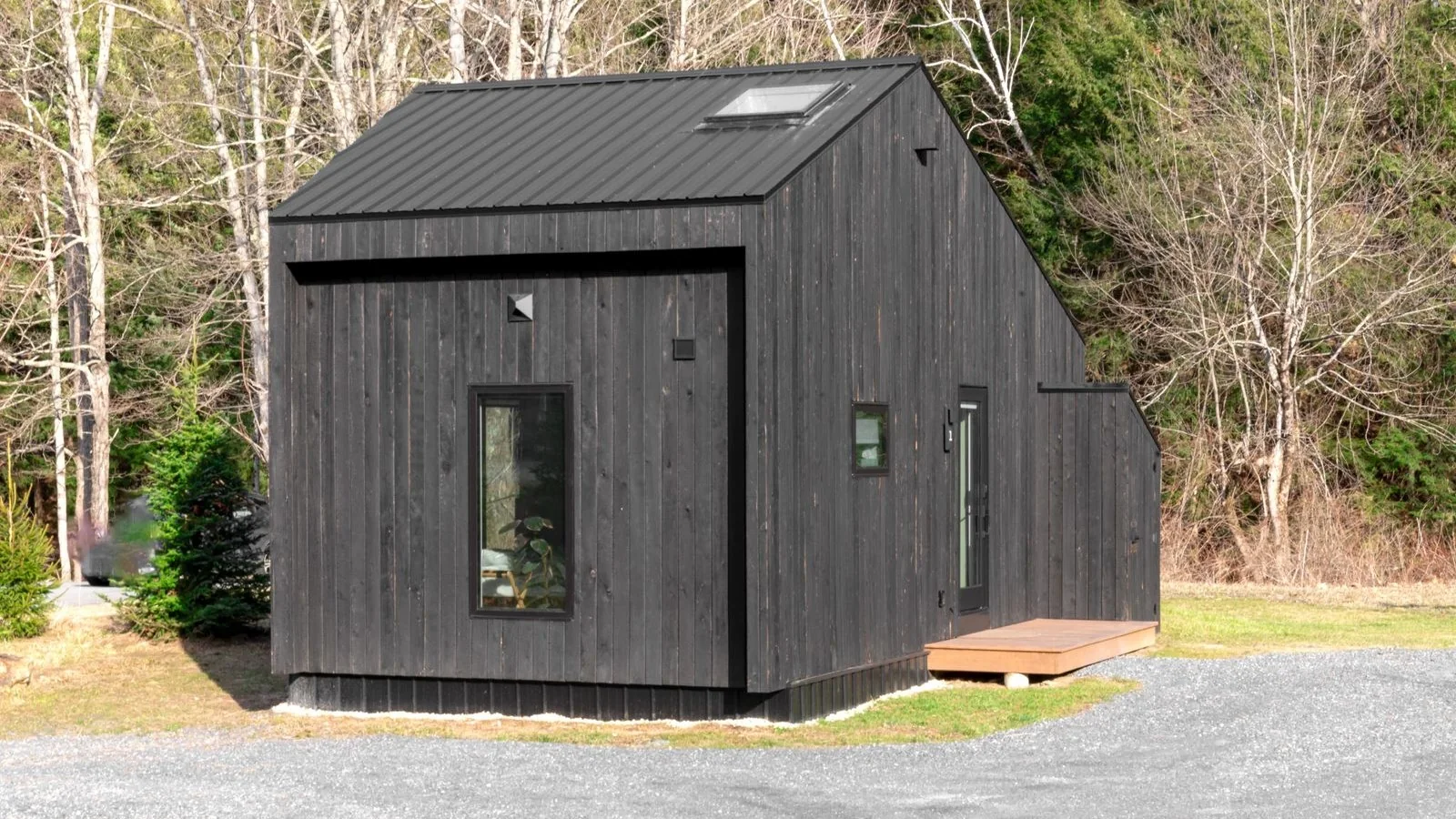
Direct answer: in Portugal, a tiny house is legal and viable, but its planning and tax status depends on two critical choices — whether it is fixed to the land (a building subject to municipal council licensing like any home) or on wheels (a caravan vehicle with its own restrictions). Realistic prices range from €30,000 to €80,000 for 20-45 m² finished, excluding land.
The tiny house has become a symbol of the simplification movement: fewer square metres, lower running costs, less maintenance. In Portugal, interest grew after 2020, driven both by housing affordability issues and by demand for holiday homes or support cabins in the interior. But there is a great deal of confusion about what is allowed, what it costs and where it makes sense. This article does the sums honestly and shows in which cases the tiny house beats a modular T1/T2, and in which cases it loses out.
What a tiny house is (in Portugal)
There is no single legal definition. In practice, a tiny house is a compact dwelling with 15-50 m² of usable space, designed for extreme spatial efficiency: mezzanine bed, compact kitchen, bathroom with a shrunken shower, vertical storage. There are two families that must be treated separately:
- Fixed tiny house — set on a foundation (pad footings or metal piles), connected to public utilities or autonomous solutions, without vehicle type approval. Legally it is a new building.
- Tiny house on wheels (THoW) — built on a chassis with axles, registered as a trailer, towed by a tractor vehicle. Legally it is a caravan vehicle.
Each has completely different rules. Choosing the right category before ordering is essential — switching afterwards is expensive and sometimes impossible.
Real price in Portugal: €30,000 to €80,000
Prices depend on floor area, level of finish, whether it is a self-assembly kit or turnkey, and thermal performance. Here are the ranges observed in the 2026 market:
| Type | Usable area | Turnkey price | Notes |
|---|---|---|---|
| Basic self-assembly kit | 15-25 m² | €18,000-32,000 | Not licensed, client assembles |
| Fixed budget modular tiny | 25-35 m² | €32,000-50,000 | Licensable, standard envelope |
| Fixed Passive House tiny | 30-45 m² | €55,000-80,000 | Turnkey, PH envelope |
| Tiny on wheels (THoW) | 15-25 m² | €40,000-70,000 | Approved as caravan |
| Passive House modular T1 | 55-70 m² | €95,000-130,000 | Comparison reference |
These prices exclude land, utility connections, architectural project for licensing (€2,500-5,000) and municipal council fees. A licensed tiny house arrives on-site at a total cost close to €55,000-95,000, versus €100,000-140,000 for a modular T1.
Licensing: fixed vs mobile
This is the point that causes the most problems. The two options fall under different legal regimes.
Fixed tiny house (permanent)
It is new construction for the purposes of the RJUE (DL 555/99 — Portuguese building code). It requires exactly the same elements as an ordinary home:
- Architectural project signed by an architect registered with the Order.
- Engineering specialities (structural, DL 101-D/2020 thermal, RRAE acoustics, electrical, ITED telecoms, gas, water, drainage and SCIE fire safety).
- Building permit application to the municipal council or prior communication with deadline (depending on the PDM municipal master plan).
- TMU, TRIU fees and administrative charges.
- Final inspection and occupancy licence issued before habitation.
The good news: because the area is small (<50 m²), many municipal councils apply reduced or proportional fees, and case handling tends to be faster (2-4 months rather than 4-8 for a large home).
Tiny house on wheels (mobile)
It is a caravan vehicle if properly type-approved. The following apply:
- Registration at the IMT (Portuguese transport authority) as a trailer with its own number plate.
- Mandatory periodic inspection (IPO).
- ISV (Portuguese vehicle tax) if imported from outside the EU; exempt if produced in the EU.
- Parking only in authorised sites, private land with owner's permission, or rural zones without restrictive urban zoning.
- Cannot remain permanently connected to public utilities without moving into a fixed housing regime.
Note: if the municipal council detects that a THoW has been parked on the same plot for months, connected to utilities and in permanent residential use, it can be reclassified as an irregular building and become subject to fines or a removal order.
Where you may place a tiny house in Portugal
The single most important rule: the municipal council's PDM does not allow new construction on land classified as rustic, except in very specific cases (housing for a proven agricultural activity). Not even a 20 m² tiny house is an exception. If you buy rustic land hoping to "dodge" the PDM with a tiny house, you are effectively buying a lawsuit.
| Zone | Fixed tiny allowed? | THoW allowed? |
|---|---|---|
| Urbanised land (P1/P2/P3) | Yes (with project) | Yes (with owner's permission) |
| Urbanisable land | Yes (with PP and permit) | Yes |
| Rustic agricultural/forestry land | No (general rule) | Not permanently |
| Urban containment zone | Restricted | Restricted |
| Protected Area (PNSACV, Ria Formosa) | No | No |
| Authorised campsite | Not applicable | Yes (per stay) |
| Tourist development | Yes (tourism regime) | Yes (specific sites) |
Before buying a tiny house, check with the municipal council covering your plot: PDM, permits, maximum building height, setbacks and landscape restrictions. A prior information request (PIP) for €250-500 gives formal clarity before you spend €50,000 on the house.
Taxes and running costs
Once installed, a tiny house has tax obligations equivalent to any other home:
- IMI (Portuguese municipal property tax) — applies to the fixed tiny house, based on the VPT assessed by the Tax Authority. Exempt for the first 3 years for a primary residence up to certain limits.
- IMT (Portuguese property transfer tax) on the land purchase (if applicable), by bracket.
- ISV (Portuguese vehicle tax) only on a THoW imported from outside the EU.
- Water, electricity and sewerage meters — if you connect to the public grid, connection fees (€400-1,500 per service) and normal monthly bills apply.
- Off-grid — if you choose a borehole, solar panels and septic tank, upfront cost is €8,000-15,000 but no monthly bills.
Services: water, electricity, sewerage
Many tiny houses are sold with an "off-grid" pitch. The reality in Portugal is more complex:
- Water: a borehole requires a licence from the APA (Portuguese Environment Agency). An unlicensed borehole is illegal.
- Sewerage: a septic tank requires a design approved by the municipal council and an inspection. A composting toilet requires a case-by-case assessment.
- Electricity: off-grid solar panels up to 350 W are exempt from licensing; above that, prior notification to the DGEG (Portuguese energy authority) is required.
- Heating and DHW: in a Passive House tiny with a 3 kW heat pump, annual energy cost is €200-350.
Comparison with a Passive House modular T1
For the same client type (couple, no children, seeking compact), how does a 35 m² tiny house compare with a 60 m² Passive House modular T1?
| Criterion | Tiny PH 35 m² | Modular PH T1 60 m² |
|---|---|---|
| Turnkey price | €72,000 | €108,000 |
| Price per m² | €2,060 | €1,800 |
| Annual energy consumption | 15-25 kWh/m² | 15-25 kWh/m² |
| Structural service life | 50-70 years | 60-80 years |
| Bank financing | Difficult (low VPT) | Normal (LTV up to 80%) |
| Family scalability | None | Future extension possible |
| Property value | €2,000-2,500/m² | €2,400-3,000/m² |
| Rural tourism / short-let | Excellent | Good |
The tiny house has a lower absolute price but a higher price per m² — it is a premium option per unit area. For couples who want to live with a minimal footprint, or for a second holiday home in a rural area, it makes perfect sense. For a family with children or a growth horizon, a modular T1/T2 wins.
"The tiny house is not a cheap version of a home. It is a lifestyle choice with its own constraints. When that is the choice, a 35 m² Passive House tiny is excellent. When it isn't, the client regrets it within 2-3 years."
Plot requirements for a fixed tiny house
If you go for a licensed fixed tiny, the plot should have these characteristics for the process to run smoothly:
- Compatible planning classification (urbanised or urbanisable land — check via PIP).
- Minimum area per the PDM (varies between 300 and 1,000 m² depending on the municipal council).
- Frontage to a serviced road (with water and electricity within reasonable distance).
- Compatible elevations (no height limits far below the tiny — 3-4 m tall).
- No easements or encumbrances that prevent building.
Conclusion
Tiny house in Portugal is a real, viable and legally framed option — provided you choose correctly between fixed (building) or mobile (vehicle), and respect the PDM and RJUE rules. It is not a "licensing escape route" nor a shortcut to living on rustic land. For the right profile — couple, minimalism, second home, rural tourism — it is a smart choice. For growing families, a Passive House modular T1/T2 is better.
If you are considering a tiny house or a modular T1 in the Algarve, ask us for a comparative quote: we present both options side by side with fixed price, timeline and energy consumption simulation. Also see our Villa Algarve and Villa Algoz models to see the quality achievable at each level.
Figures and comparisons shown are 2026 market estimates and may vary by project, plot and supplier.
→ Request a comparative tiny vs modular quote (48h) or check our step-by-step process for licensing and works.