
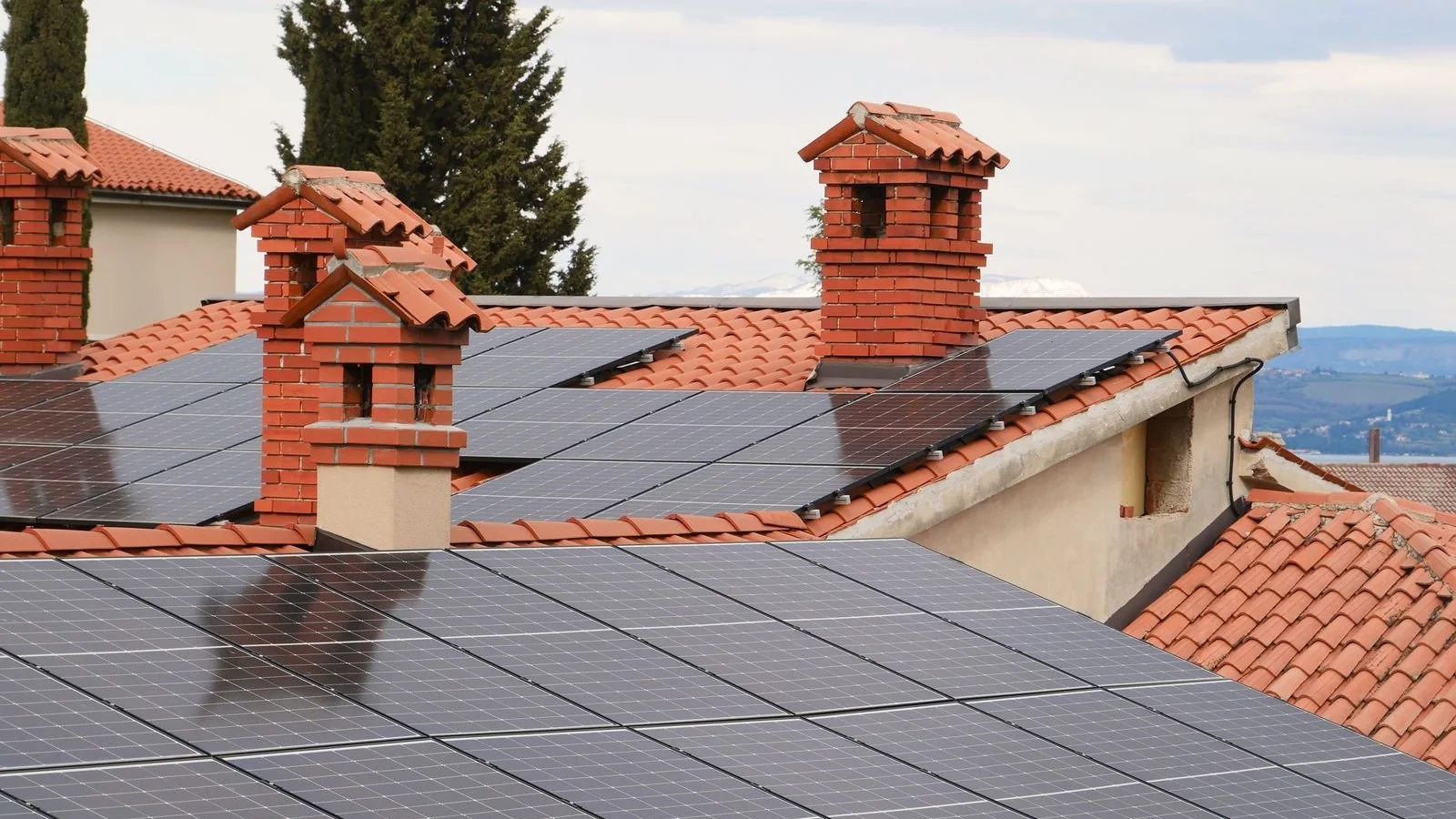
Direct answer: yes, almost always. On a Passive House in the Algarve in 2026, a 3 to 6 kWp photovoltaic system costs €4,500 to €8,500 turnkey, produces 5,500-9,500 kWh/year and pays back in 5 to 7 years. The combination with a heat pump for domestic hot water satisfies the renewable contribution requirement of DL 101-D/2020 and eliminates the need for solar thermal. Storage batteries rarely pay off in 2026 (over 10-year payback). In short-term rental homes, yields are even higher — peak production in July-August coincides with peak occupancy.
This article gives you the realistic numbers to decide: price, expected production in the Algarve, integration with heat pump and pool, alternatives to solar thermal, and when it makes sense — or not — to invest in a battery.
Context: why the Algarve is ideal for photovoltaics
The Algarve has some of the best solar conditions in all of Europe. Annual global horizontal irradiation reaches 1,850-1,950 kWh/m² in Faro, compared with 1,100-1,250 kWh/m² in Munich, 1,050 kWh/m² in Berlin and 950 kWh/m² in Copenhagen. Translated into useful photovoltaic output: 1 kWp installed in the Algarve produces 1,550-1,650 kWh/year against 900-1,000 kWh/year in central Germany. That is 60% more.
In addition, the solar production curve in the Algarve matches the home consumption curve well: peak radiation between 11 am and 4 pm — which is also the peak of cooling (heat pump producing cold) and pool use. In short-term rental, the peak occupancy season (June to September) is exactly the peak PV production season. Few geographies in the world have this favourable overlap.
Solar thermal vs photovoltaic in 2026
Historically, the REH required solar thermal panels for domestic hot water production. Its legal successor — DL 101-D/2020 — requires a renewable energy contribution for DHW but accepts three equivalent alternatives:
- Classic solar thermal: 2-3 m² of collectors + 200-300 L storage tank. Cost €2,500-4,000. Annual maintenance required (check pressure, glycol, anode). Risk of overheating in the Algarve summer (stagnation above 130°C).
- DHW heat pump: compact 200-260 L unit integrated with evaporator. Cost €2,200-3,500. Nominal COP 2.7-3.5. No overheating, no critical annual maintenance. Consumes electricity — which can be generated by the PV system itself.
- Dedicated PV for DHW: annual production is accounted for as attributed to water heating. A more versatile solution — the same panels produce for DHW, lighting, appliances and climate control.
In a Passive House in the Algarve, the winning combination in 2026 is PV + heat pump for DHW. It eliminates the risks of solar thermal (overheating, critical maintenance, bulky storage tank) and comfortably satisfies DL 101-D/2020.
Photovoltaic system prices in 2026
Turnkey values observed on quality residential installations in Portugal in 2025-2026, with Tier 1 monocrystalline panels, European-brand hybrid inverter and certified cabling:
| Capacity | Panels (400 W) | Turnkey price | Annual output Algarve |
|---|---|---|---|
| 3 kWp | 8 panels | €4,500 – €5,500 | 4,700 – 5,100 kWh |
| 4 kWp | 10 panels | €5,500 – €6,800 | 6,200 – 6,700 kWh |
| 5 kWp | 13 panels | €6,800 – €8,000 | 7,700 – 8,400 kWh |
| 6 kWp | 15 panels | €7,800 – €9,200 | 9,200 – 10,100 kWh |
Values with 23% VAT included, installation, grid connection under self-consumption with surplus (Modality B of DL 15/2022) and prior notification to DGEG (Portuguese Directorate-General for Energy and Geology). Typical sizing for a T3 Passive House in the Algarve: 4 kWp with heat pump for DHW and climate control; 5-6 kWp if there is a heated pool and/or an electric car.
Simple self-consumption vs self-consumption with surplus
The Portuguese regulatory framework for self-consumption is DL 15/2022 (which repealed DL 162/2019), with DGEG regulations updated in 2024. Two modalities are relevant for residential use:
- Simple self-consumption (Modality A): no surplus injection to the grid. All output is instantly self-consumed or lost. Makes sense on small systems (<1.5 kWp) or in homes with constant, high consumption.
- Self-consumption with surplus (Modality B): a bidirectional meter is fitted; injected surplus is paid at the OMIE rate less charges. It is the standard modality for 90% of residential installations in Portugal in 2026.
Surplus remuneration in 2025-2026 has oscillated between €0.04 and €0.08/kWh injected — well below the purchase price (€0.17-0.22/kWh on the simple tariff). Optimal sizing therefore maximises the self-consumption rate (kWh consumed internally / kWh produced): ideally 55-70%.
Payback: the realistic numbers
Let's use a concrete example. A T3 Passive House in Silves, 4 kWp installed, annual electricity consumption 5,500 kWh (heat pump climate + DHW + LED lighting + A+++ appliances):
- Annual output: ~6,500 kWh.
- Instant self-consumption (60% of output): 3,900 kWh × €0.19 avoided = €741 direct saving/year.
- Surplus injected (40% of output): 2,600 kWh × €0.06 = €156 annual revenue.
- Total annual gain: ~€897.
- Investment: €6,300 (4 kWp turnkey).
- Simple payback: ~7 years. Payback adjusted for electricity tariff inflation (+3%/year): ~5.5 years.
In short-term rental, summer production coincides with peak consumption (heat pump cooling for guests, heated pool) — self-consumption rate rises to 70-80% and payback drops to 4.5-6 years.
Batteries — worth it in 2026?
In most residential cases in the Algarve, no. A 5-10 kWh lithium (LFP) battery costs €2,500-5,000 turnkey in 2026, with a 10-year warranty at 60-70% residual capacity. It allows you to:
- Shift 40-60% of daytime output to night-time consumption.
- Raise the overall self-consumption rate from 60% to 80-85%.
- Additional saving over a system without a battery: €200-350/year.
The battery's standalone payback is 10-15 years, longer than the guaranteed useful life. It therefore only makes sense in three specific scenarios:
- House in a rural area with unstable grid: the battery provides backup during grid outages (with a hybrid inverter in island mode).
- High night-time consumption from an electric car: charging the car at night with energy stored from daytime output makes the maths favourable.
- Resilience requirement: for those who value service continuity in extended outages (rare in the Algarve, but relevant in isolated areas).
Integration with heat pump and pool
In an Ecoimport Wood Passive House, the PV is sized in conjunction with the building services. Four critical integrations:
- DHW heat pump: water heating at midday, when solar output is at its peak. 200 L storage tank with thermostat scheduled to produce between 11 am and 3 pm. Direct self-consumption of almost 100% of the energy used for DHW.
- Climate heat pump: air conditioning activated in pre-cooling mode during peak solar hours. This strategy is particularly effective in a Passive House thanks to the high thermal inertia of the insulated envelope — the house holds 22-24°C for 6-8 hours with no consumption once pre-cooled.
- Heated pool: a pool heat pump draws 4-8 kWh/h in heating mode and is the ideal household load for solar self-consumption — it runs during the day, when the sun is out. Sizing an extra 1-2 kWp dedicated to the pool raises overall return.
- Electric car: charger with smart management synchronised to solar output. Beyond the Passive House scope but a natural multiplier of PV return in a modern home.
"A well-sized PV system on an Algarve Passive House pays back in 5-7 years. On a Passive House with short-term rental, in 4-6. Few home investments have this return."
Annual maintenance
Photovoltaic panels are among the lowest-maintenance items in a home. Basic annual routine:
- Wash the panels with clean water (once a year in the Algarve, twice if there is limescale dust nearby). Cost €50-100 contracted.
- Visual check of the inverter (status LED) — can be done by the user weekly.
- Meter readings compared with expected output — detects anomalous losses.
- Professional check every 5 years: DC terminal tightening, verification of protections, inverter calibration. Cost €120-200.
Conclusion
Photovoltaic solar panels on a Passive House in the Algarve are one of the rare home investments with payback under 10 years and revenue thereafter. The combination of Passive House envelope + PV + heat pump creates a home that produces more energy than it consumes on an annual average — certifiable Passive House Plus and, in some cases, Premium. Battery storage is a debatable option in 2026; solar thermal is rarely the best choice in new construction; and integration with electric car, pool and climate control multiplies the initial return. A PV system is not an accessory — it is critical infrastructure for a modern Class A home in the Algarve.
Figures and comparisons shown are 2026 market estimates and may vary by project, plot and supplier.
→ Get your turnkey quote with PV included (48h) or see our Passive House technology page.