The question comes almost every week: a house in the Algarve, without AC, in August? The short answer is yes — but it depends on the envelope, orientation and ventilation. The long answer is here, with numbers from our Algoz showroom.
What is a Passive House
A Passive House is a house whose envelope (walls, roof, slab, windows) is so efficient that the energy needed to heat or cool the interior is a fraction of what a conventional house uses. It's a technical standard, with objective criteria:
- Useful heating energy demand ≤ 15 kWh/m²·year
- Useful cooling energy demand ≤ 15 kWh/m²·year
- Air tightness n₅₀ ≤ 0.6 h⁻¹
"It's not a house that just 'uses little energy'. It's a house whose envelope works for you — the interior stays stable almost without mechanical intervention."
What changes in an Algarve Passive House
In the Algarve, summer is the challenge. The envelope must keep heat out. We work with four principles:
- Continuous insulation: 250–300 mm equivalent of mineral wool or cork, without gaps.
- Envelope under the slab: XPS under the concrete slab eliminates the thermal bridge with the ground.
- Shading of south and west openings: canopies, exterior shutters, vegetation.
- Night ventilation: passive cooling using the day-night thermal difference.
Real numbers from the showroom
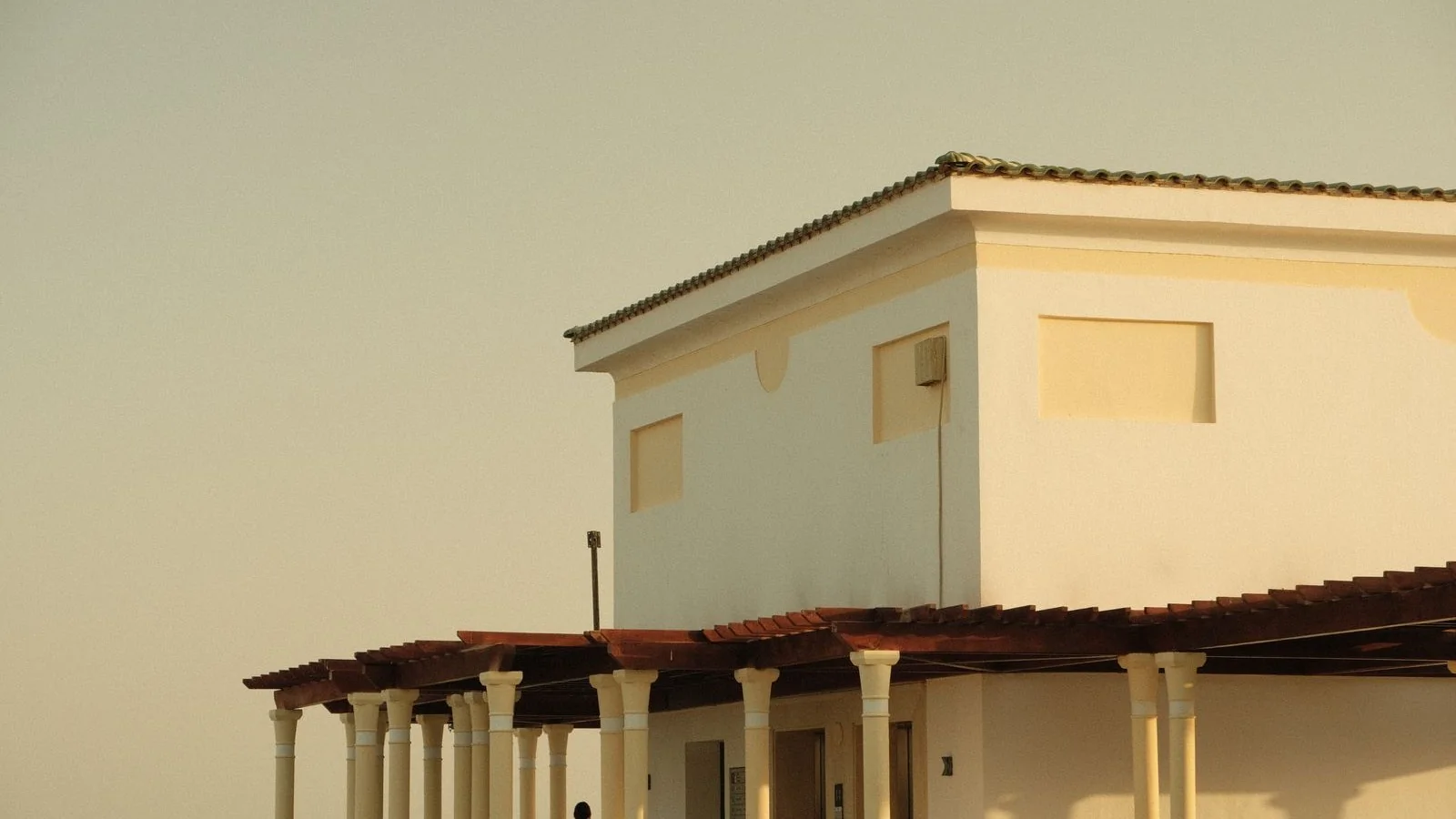
At the house we are building in Algoz, with the thermometre reading 38 °C outside on 15 August 2026, we measured a stable interior temperature of 24.5 °C — with no air conditioning on. Daily electricity use: 3.8 kWh, for appliances and lighting only.
Technical checklist to verify a genuine Passive House
The "Passive House" label is used loosely in the Portuguese market. Before signing a contract, ask the builder for written documentation on each of the eight items below. If any of them are missing, it is not a Passive House — it is marketing.
- Blower door test with n₅₀ ≤ 0.6 h⁻¹. It is the only test that proves real airtightness. Ask for the signed report with the pressure curve at 50 Pa; values above 1.0 h⁻¹ indicate ordinary construction, not passive.
- Continuous insulation with declared thickness. For the Algarve climate, minimum 200 mm mineral wool (λ ≤ 0.035 W/m·K) or 240 mm expanded cork (ICB) on external walls, and 300 mm on the roof. Ask for the insulation datasheet with thermal conductivity value.
- MVHR unit with recovery efficiency ≥ 80%. Reference brands: Zehnder ComfoAir, Paul Novus, Vallox. Efficiency below 75% makes it impossible to meet the useful-energy limits.
- PHPP calculation delivered in Excel. The Passive House Planning Package is the official tool of the Passivhaus Institut. Without PHPP there is no proof that the project meets the limits — only assumptions.
- Windows with Uw ≤ 0.85 W/m²·K. PVC or wood-aluminium frame with low-emissivity triple glazing. Datasheets with brand (Internorm, Reynaers, Rehau Geneo) and certified value.
- Thermal bridge calculation with Ψ ≤ 0.01 W/m·K. All junctions (wall/slab, wall/roof, jambs) must be modelled in 2D software (Therm or Flixo) with a report attached.
- Airtightness certificate issued at end of works. A "commercial" test is not enough. The official test must be performed in two stages (after the envelope is closed and at completion) by a certified independent technician.
- Orientation-based shading study. Graphical analysis of solar angles in June and December for every south and west opening, with sizing of overhangs or external shutters. Without dimensioned passive shading, the Algarve summer wrecks the cooling balance.
A builder who hesitates to provide any of these documents before the contract is, without saying so, telling you that the project does not have them.
Conclusion
Yes, you can get through summer without AC — in comfort, not in resistance. And it's not magic: it's envelope, orientation and ventilation engineering. A Passive House in the Algarve is today the most efficient way to live in the south.