
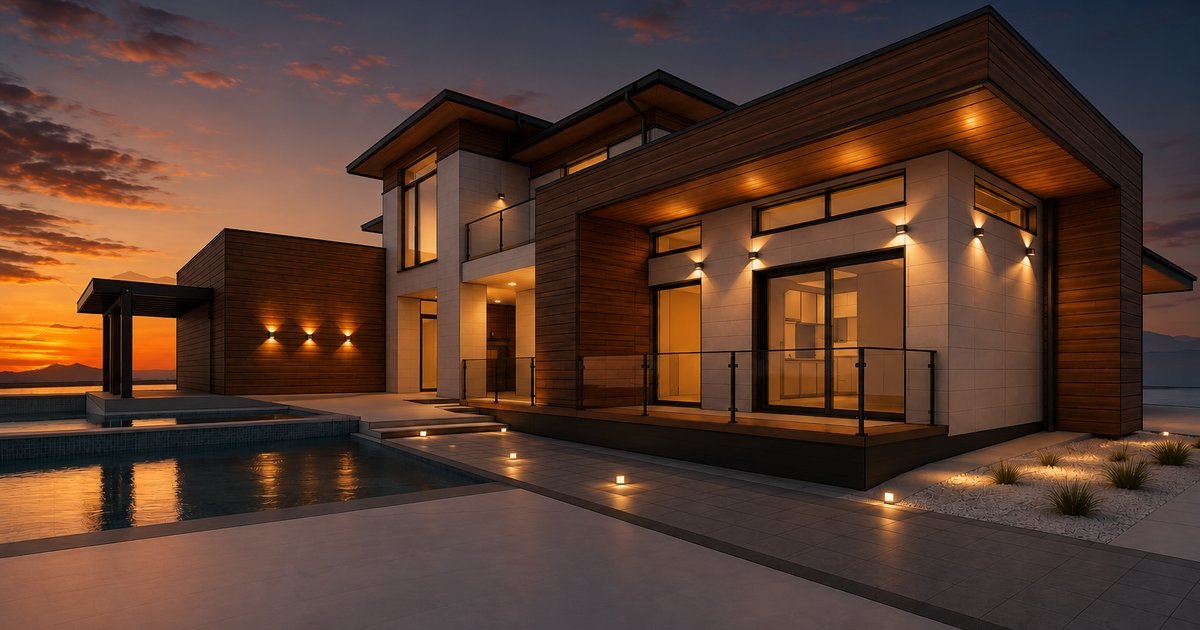
Direct answer: an off-grid container home in the Algarve is technically viable and economically competitive if the plot is far from public utilities (the distance factor). The additional investment for full autonomy is typically €15,000-€28,000 (solar + battery + water harvesting + individual ETAR), which pays off when extending the networks would exceed €20,000. Solar autonomy in the Algarve is favoured by excellent solar resource (2,800-3,000 hours of sun/year), but the Algarve winter (Dec-Feb) requires rigorous sizing for 4-5 days of autonomy without using the backup generator.
The off-grid option in a container home is increasingly sought after by three profiles: isolated rural plots where grid connection is expensive, buyers with a self-sufficiency ethos, and seasonal second homes where controlled consumption is compatible. This article shows real sizing, costs and limitations.
For the general legal framework, see container houses in Portugal. To contrast with a grid-tied Passive House, see solar panels on Passive House.
Solar autonomy: sizing in the Algarve
The Algarve has 2,800-3,000 annual hours of sun and average irradiation of 5-5.5 kWh/m²/day — excellent for photovoltaic solar. For a T1 container home with controlled consumption:
- Typical annual consumption: 2,500-4,000 kWh/year (A+++ fridge, LED lighting, pumping, small appliances).
- Solar panels: 2.5-4 kWp (6 to 10 panels of 400 W).
- Battery: 10-15 kWh in LiFePO4 (lithium iron phosphate), for 2-3 typical days of autonomy.
- Hybrid inverter: 3-5 kW with UPS function.
- Backup generator: 2-4 kW petrol or propane, for 5-10 days without sun (rare in the Algarve).
Typical cost: €8,000-€14,000 for a complete system. Panel lifespan: 25 years; LiFePO4 battery lifespan: 10-15 years.
Water capture and treatment
Without a public network, three complementary sources:
- Rainwater harvesting — the container roof collects about 400-700 litres per mm of rain per 100 m² of roof area. In the Algarve, average annual rainfall (400-600 mm) yields 160,000-420,000 litres per 100 m² — but concentrated in Oct-Mar.
- Artesian borehole / well — typically 20-80 m deep in the Algarve. Drilling costs: €2,500-€6,000. Must be licensed through APA (Portuguese Environmental Agency).
- Storage tank — 5,000-15,000 L in buried polyethylene or concrete cistern. Cost: €2,000-€5,000 installed.
- Treatment: mechanical filtration + UV (no chemicals); for potable water, reverse osmosis at point-of-use for the kitchen.
Typical cost of the full system: €7,000-€14,000 for borehole + tank + filtration + treatment, including pipework and pumping.
Sanitation without a public sewer
Two solutions compliant with Portuguese law:
- Septic tank + absorption pit — the traditional solution. Capacity 1,500-3,000 L (depending on number of users). Dimensions regulated by decree. Requires soil permeability analysis. Cost: €2,000-€4,000.
- Individual ETAR — compact micro-treatment plant. Treats wastewater to a quality higher than a septic tank; allows discharge to an authorised watercourse or soil infiltration. More expensive but environmentally superior. Cost: €4,500-€9,000.
Both solutions require licensing from APA (discharge) and the council (building). Individual ETARs are increasingly favoured in sensitive zones (REN, protected areas).
Off-grid legalisation: meeting the requirements
Autonomy does not exempt from licensing. The specific points to cover in the design:
- Thermal design (SCE) — the home cannot be exempt from energy certification just because it is off-grid. The SCE calculates reference consumption; photovoltaic generation enters as a "renewable source" that can lead to Class A.
- Solar licensing — systems up to 30 kVA in self-consumption are prior notice to DGEG (no licence). Easy and quick.
- Water capture licensing — a borehole requires an APA licence. Rainwater harvesting does not require a licence if for private domestic use.
- Sanitation licensing — septic tank or ETAR require soil permeability evidence + distance from water sources + approval in the specialities design.
Total investment and payback
| Component | Typical cost | Note |
|---|---|---|
| Solar + battery + inverter system | €8,000-€14,000 | Life 10-25 years |
| Artesian borehole | €2,500-€6,000 | Life 30-50 years |
| Tank + water treatment | €4,000-€8,000 | Life 15-30 years |
| Individual ETAR | €4,500-€9,000 | Life 20-30 years |
| Backup generator | €1,500-€3,000 | Life 10-15 years |
| Typical off-grid total | €20,500-€40,000 | Initial investment |
| Alternative: connecting to public networks | €5,000-€30,000 | Depends on distance |
Off-grid payback depends essentially on the distance to the networks. If extending the electricity network costs more than €15,000 and water more than €10,000, off-grid becomes competitive in direct cost — and eliminates monthly bills (€300-€800/year in total).
Off-grid in container vs in Passive House
Final comparison: an off-grid container has the same technical mechanics as an off-grid Passive House, but:
- Energy consumption — a Passive House uses 50-70% less for the same comfort (insulated envelope 250-300 mm vs minimum insulation in a container), allowing a smaller solar system.
- Water harvesting — the larger roof area of a Passive House yields more rainwater litres.
- Indoor air quality — Passive House with MVHR-RC filtered vs container with natural ventilation (humidity and condensation).
- Durability — Passive House 60+ years vs container 20-30 years with maintenance.
For specific solar sizing in Passive House, see solar panels on Passive House.
Figures and procedures are indicative for the Algarve market. Each project is assessed individually according to plot, council and specific technical requirements.
→ Request your personalised quote in 48h or see our process with real photos from site.