Direct answer: yes, a well-designed structural timber home stands up perfectly to the Algarve climate — intense sun, coastal humidity, salinity and extreme summer temperatures. It doesn't just withstand it — it lasts more than 100 years, with minimal maintenance. The secret lies in the Passive House building envelope and the type of timber used.
This is one of the biggest myths about modular construction in Portugal. It's worth dismantling it with engineering, not marketing.
Which timber is used in an Ecoimport Wood build?
The structure of our modular homes is made from KVH (Konstruktionsvollholz) — solid structural timber in Nordic spruce or pine, mechanically graded C24, pressure-treated in autoclave against xylophagous attack (fungi, insects, termites), with moisture stabilised below 15%. The timber is FSC-certified (Forest Stewardship Council) and comes from sustainably managed forests in Germany, Austria or Scandinavia.
For larger beams and roofs we use BSH (Brettschichtholz) — glued laminated timber, also C24, with structural strength comparable to structural steel in large beams and predictable behaviour over decades.
What attacks timber, in practice
There are three main aggressors that worry anyone who hears "timber home":
- Prolonged humidity — only a problem if the timber gets wet and doesn't dry. Water stagnation + lack of ventilation = fungi.
- Xylophagous insects, including Reticulitermes (subterranean termites present in the Algarve).
- UV rays — degrade the surface of exterior timber cladding.
All three have well-known technical solutions, tested in thousands of modular homes built in Germany, Austria, Switzerland and Scandinavia since the 1970s. Let's look at each one.
Humidity: how the Passive House envelope solves it
The fundamental rule is to keep the structural timber always dry. This is achieved through three layers of the panel-frame:
- Vapour barrier on the interior side — prevents household moisture (breathing, cooking, bathing) from entering the timber structure.
- Continuous insulation based on mineral wool or blown-in cellulose — creates stable hygrothermal conditions inside the wall.
- Water barrier / vapour-permeable membrane on the exterior side — prevents rain ingress but allows any residual moisture to escape.
Additionally, all our homes include mechanical ventilation with heat recovery (MVHR). This continuously renews interior air, keeping ambient humidity between 40 and 60% — well below the risk threshold for fungi.
Result: the structural timber never sees liquid water and is never in a vapour-saturated environment. There are no conditions for it to rot.
Termites and insects: real risk and how to eliminate it
The Algarve has subterranean termites (Reticulitermes lucifugus, mainly). They are a real threat to any structural timber in contact with the ground — in traditional homes with timber joists, rustic outbuildings, pergolas. Two technical defences virtually eliminate the risk:
- Autoclave class 2 treatment — the timber is impregnated with biocide under pressure. Treatment lifespan: over 50 years.
- Physical isolation from the ground — in our homes, structural timber starts above the reinforced concrete slab, which in turn rests on XPS. Subterranean termites cannot cross 20 cm of concrete + XPS.
We still recommend an annual visual inspection of the exterior perimetre — as advised for any home in the Algarve, whether timber, brick or concrete.
Sun and UV: what changes at the facades
The Algarve sun is intense — we get 300+ days/year. This affects two things: exterior cladding and interior temperature.
Interior temperature: we've seen in another article that a Passive House in the Algarve maintains 24° C interior with 38° C exterior, without AC. The insulated envelope + shading + night ventilation works in summer.
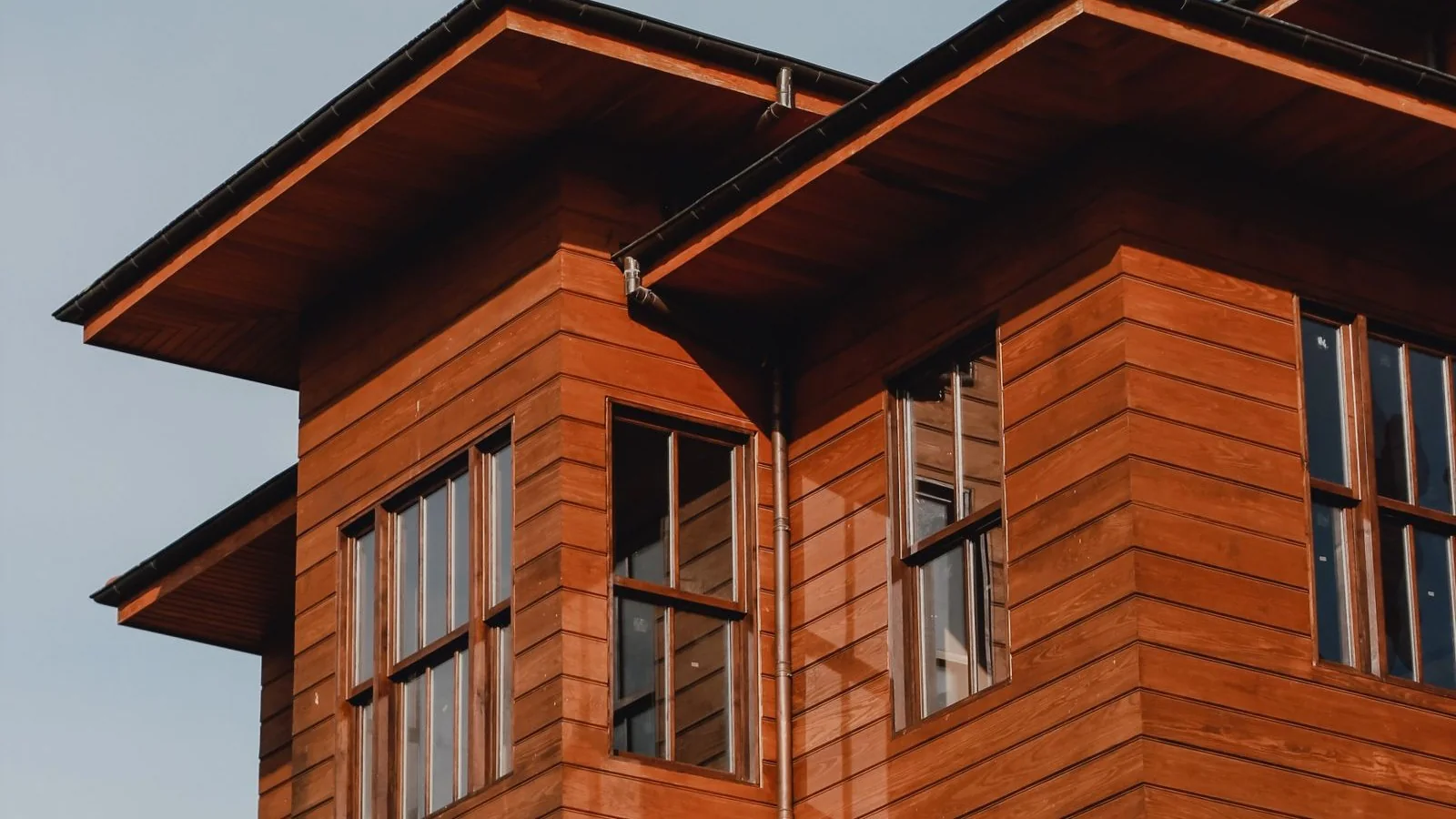
Exterior cladding: here you have options. Our clients choose between:
- Certified timber slats — warm and natural look, requires UV varnish renewal every 8-10 years, lasts 15-20 years before partial replacement. Mid-range cost/m².
- Fibre cement panel — zero maintenance, contemporary look, UV- and salt-resistant, lasts 40+ years without intervention.
- Standing seam metal panel — modern look, lasts 50+ years, resistant to everything.
Note that these cladding options protect the timber structure behind them — the structural timber never sees direct sunlight.
Sea salt: what about near the sea?
Coastal areas (Albufeira, Portimão, Lagos, Vilamoura) have salinity that rapidly degrades exposed metal structures and some cladding. Structural timber itself is indifferent to salt — sodium chloride does not attack it. What can be affected is the chosen exterior cladding. For homes within 500 m of the coast we recommend fibre cement or standing seam cladding. For inland homes, timber slats are an aesthetically valid choice.
Historic timber homes in Portugal
This is not new knowledge. Portugal has structural timber homes over 200 years old still in use — the "Swiss chalet" of Sintra, houses in Águeda, farmhouses in the Beiras. All of northern Europe has been building this way for centuries: over 90% of Nordic single-family homes are structural timber. It's not a new experiment.
What is new is the combination of: (1) certified European structural timber, (2) automated factory manufacturing, (3) Passive House envelope, and (4) fast on-site assembly. That's what we do.
Fire resistance
Against the common myth: glued laminated timber structures resist fire better than steel structures. Steel loses 50% of its capacity at 550° C and collapses. Timber chars on the outside at a predictable rate (0.7 mm/min) while keeping its structural core intact for much longer. Our walls meet the requirements of the SCIE regime (Portuguese Fire Safety in Buildings, DL 220/2008) applicable to utilização-tipo I (residential use), with REI 60 resistance in load-bearing walls.
The interior also has mandatory smoke detectors and the electrical installations follow the standard IEC regulation.
Real annual maintenance
An Ecoimport Wood home requires maintenance equivalent to or lower than a well-built traditional home. Realistic checklist:
- Annual: visual inspection of the exterior perimeter, gutter cleaning, checking opening seals, changing mechanical ventilation filters (~€25/year).
- Every 3 years: overhaul of exterior plumbing connections.
- Every 8-10 years: UV varnish renewal on exterior timber cladding (if applicable, ~€800–1,500 for a T3).
- Every 15-20 years: spot replacement of deteriorated slat boards.
Estimated average annual cost: €150–250. Lower than the average annual maintenance costs of traditional homes in the Algarve, mainly due to the absence of structural moisture.
How to verify timber quality: 5 critical signs
Structural timber is not all equal. Two houses of similar size can behave radically differently over 40 years depending on the origin, processing and grading of the wood used. Before signing a contract, ask for written documentation on the following five points.
- FSC or PEFC certificate from the timber supplier. FSC (Forest Stewardship Council) or PEFC (Programme for the Endorsement of Forest Certification) chain-of-custody proves that raw material comes from sustainably managed forests, with a certificate number verifiable in the FSC-C or PEFC/04 databases. Ask for the traceability sheet of the batch delivered on site.
- Anti-fungal and anti-termite treatment for use class 2 or 3 (EN 335). European standard EN 335 grades timber exposure in five levels; for structural elements in ventilated areas with occasional moisture (class 2) or exposed facades (class 3), autoclave treatment with products such as Wolmanit CX-8 or Tanalith E ensures penetration ≥ 4 mm and specified minimum retention in kg/m³. The treatment report with date and batch is supplied by the producer.
- KVH timber (Konstruktionsvollholz) DIN 4074-1 class S10 or S13. KVH is finger-jointed solid structural timber with stabilised 15% ±3% moisture, tight dimensional tolerance and strength grading S10 (equivalent to C24) or S13 (equivalent to C30) under the German standard DIN 4074-1. Without this grade, timber may just be called "structural" without proof of mechanical strength.
- Moisture content ≤ 15% at time of assembly. Wood above 18% warps, cracks and creates conditions for fungal growth. A serious builder measures moisture with a contact hygrometre (Gann or Merlin) at least in three points per structural element and records the values in the site logbook. Ask for access to the log.
- Written manufacturer structural warranty ≥ 30 years. A serious glulam or KVH producer (Hasslacher, Binderholz, KLH, Stora Enso, Metsä Wood) provides a minimum 30-year structural warranty for protected elements and 10 years for exposed ones, subject to maintenance conditions. Without this warranty, the entire risk falls on the owner.
These five documentary proofs must be available before invoicing. If the builder says "those are details that come later", they are effectively saying they don't have them — and nothing guarantees the timber installed matches the sales pitch.
Conclusion
The question isn't "does it stand up to the Algarve climate?" — it withstands it perfectly. The right question is: does it withstand it better than a traditional home? In many respects, yes: continuous envelope without thermal bridges, controlled interior humidity, predictable service life, summer-winter comfort without mechanical systems.
Structural timber homes are the dominant building standard in climates much harsher than the Algarve's (Scandinavia, the Alps, Alaska, Canada). Bringing this expertise to the Algarve and adapting it to our climate is what Ecoimport Wood has been doing for a decade.
→ See the Villa Algoz (T3 with timber-structured library) or learn more about the panel technology.